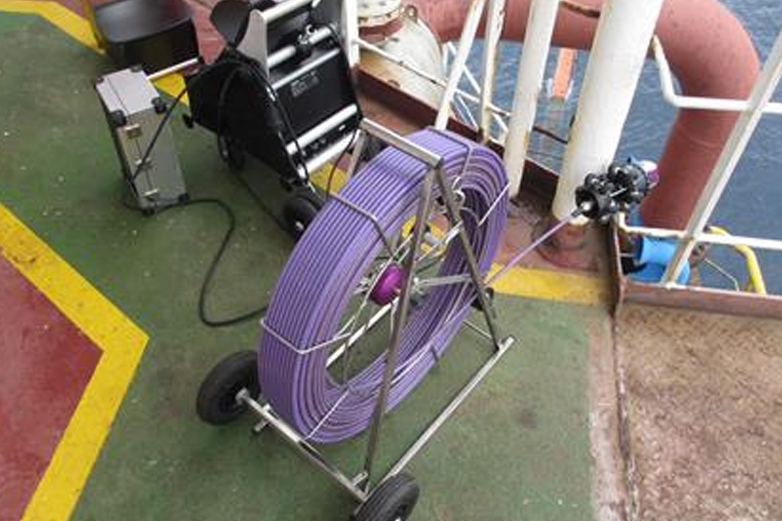
Marine Hose Internal & External Inspection by ROV and Borescope
Fairtex provides in-situ marine hose inspection services using ROV and borescope technology to evaluate the internal and external condition of offshore transfer hose systems. Our inspection services support FPSO, FSO, tanker loading, marine terminal, and offshore transfer operations where hose integrity monitoring is critical to operational continuity and transfer safety.
Inspection activities are performed following seawater flushing or nitrogen purging of hose strings where required. Using remotely operated vehicle (ROV) systems and borescope inspection equipment, Fairtex provides detailed visual assessment of hose bore condition, external structural integrity, buoyancy systems, connection areas, and operational deterioration indicators without requiring complete hose string dismantling.
Typical applications: floating hose systems, reel hoses, chute hoses, catenary hoses, FPSO offloading lines, offshore transfer systems, tanker loading operations, hose recertification support, and marine integrity monitoring programs.
What this service covers
Internal Hose Bore Inspection
Fairtex performs internal visual inspection of marine hose bores using borescope and push-rod inspection systems to identify liner damage, nipple corrosion, carcass deformation, kinking, abrasion, and other integrity concerns affecting hose operational reliability. Internal inspection supports early anomaly detection and proactive maintenance planning.
External ROV Condition Monitoring
Our ROV inspection capability enables external condition monitoring of offshore hose systems operating in marine environments with sea conditions up to approximately 1 metre swell and 1 knot current. Inspection activities assess hose condition, buoyancy configuration, bead float security, external abrasion, marine growth accumulation, and visible impact damage.
Damage & Deterioration Identification
Fairtex inspections are designed to identify early-stage deterioration and operational anomalies before they progress into critical hose failures. Our inspections target visible integrity threats including loose bolts, leak detection system activation, external wear, deformation, liner degradation, and structural abnormalities affecting offshore transfer performance.
Operational Risk Reduction
Routine in-situ inspection programs help reduce unexpected hose failure, minimize operational downtime, and support integrity-driven maintenance planning. By reducing the need for diver intervention and full hose string breakdown inspection activities, Fairtex supports improved offshore safety exposure management and more efficient inspection execution.
Lifecycle Integrity & Inspection Support
Inspection findings support maintenance planning, recertification programs, hose replacement strategy, lifecycle assessment, and operational integrity management activities aligned with OCIMF marine hose operational guidance and offshore transfer best practices.
Key Takeaways
- In-situ marine hose inspection using ROV and borescope systems
- Internal and external hose condition monitoring for offshore transfer systems
- Early detection of liner damage, corrosion, kinking, and structural anomalies
- Reduced diver exposure, downtime, and offshore inspection costs