Plate and Frame Heat Exchanger Cleaning Services
Fairtex Group provides specialized plate and frame heat exchanger cleaning services designed to restore thermal efficiency, remove fouling deposits, and ensure reliable operation of process cooling systems across industrial facilities. Plate heat exchangers are widely used due to their compact design and high heat transfer efficiency compared to shell and tube systems.
Our cleaning services are tailored to both Clean-In-Place (CIP) chemical circulation methods and full plate pack disassembly cleaning, depending on system condition, fouling severity, and operational requirements.
Typical applications: food and beverage processing, breweries, dairy plants, chemical processing, HVAC systems, industrial cooling systems, process water systems
What this service covers
Clean-In-Place (CIP) Chemical Cleaning
Fairtex performs CIP cleaning by isolating the plate heat exchanger and circulating a controlled descaling solution through the plate channels. The cleaning solution is selected based on deposit composition and is typically an inhibited acid formulation that removes scale without damaging metal surfaces.
The solution is pumped through the exchanger for a controlled circulation period, typically around eight hours, allowing effective dissolution of fouling materials before final flushing and system reinstatement.
Plate Pack Disassembly & Manual Cleaning
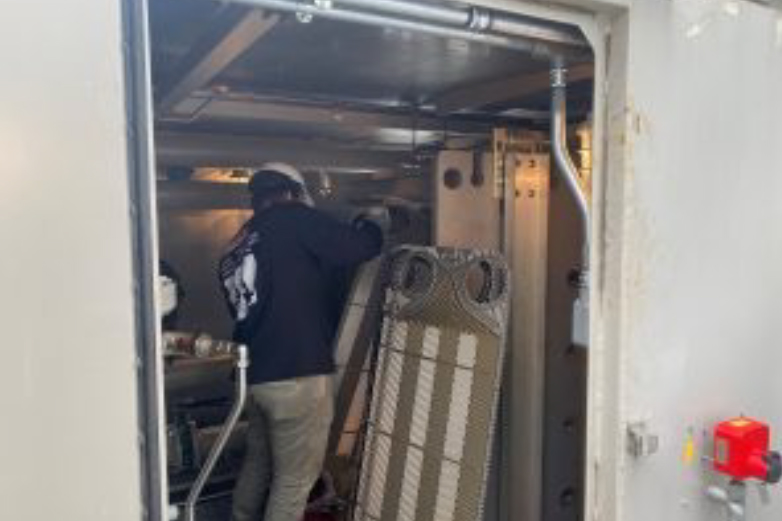
Where fouling cannot be removed through CIP methods, Fairtex performs full plate pack disassembly in accordance with manufacturer procedures. Each plate is removed, inspected, and cleaned individually using chemical agents, soft brushes, and controlled high-pressure rinsing systems.
This method ensures complete removal of deposits from plate surfaces and channel grooves, restoring full heat transfer capability before reassembly and return to service.
Chemical Descaling & Material Compatibility
We use specialized inhibited acid descalers designed to dissolve scale and fouling without damaging exchanger materials. These solutions are compatible with common plate materials including stainless steel, titanium, and copper-nickel alloys.
Cleaning agents are carefully selected to match deposit chemistry and ensure safe, controlled cleaning performance across all exchanger types.
Reassembly, Testing & Return to Service
Following cleaning, plate heat exchangers are reassembled, gasket integrity is verified, and the system is flushed with clean water. Pressure testing may be performed where required to confirm sealing integrity before the unit is returned to operational service.
Key Takeaways
- CIP chemical cleaning for efficient in-place fouling removal
- Full plate pack disassembly and manual cleaning capability
- Inhibited acid descaling safe for stainless steel and titanium plates
- Restores heat transfer efficiency and operational reliability